Stormwater & Land Management Insights for South Carolina and North Carolina Property Owners
Carolina Outdoor Services covers the topics that keep commercial properties compliant, functional, and built to last. From retention pond inspections and stormwater BMP maintenance to forestry mulching and sustainable land management — if it affects your property's drainage and long-term health, you'll find practical answers here. We serve property managers, HOAs, developers, and municipalities across the Midlands and Upstate of South Carolina and into North Carolina. Every post is written from field experience — not theory.
Stormwater & Land Management Insights for South Carolina and North Carolina Property Owners
Carolina Outdoor Services covers the topics that keep commercial properties compliant, functional, and built to last. From retention pond inspections and stormwater BMP maintenance to forestry mulching and sustainable land management — if it affects your property's drainage and long-term health, you'll find practical answers here. We serve property managers, HOAs, developers, and municipalities across the Midlands and Upstate of South Carolina and into North Carolina. Every post is written from field experience — not theory.
Stormwater & Land Management Insights for South Carolina and North Carolina Property Owners
Carolina Outdoor Services covers the topics that keep commercial properties compliant, functional, and built to last. From retention pond inspections and stormwater BMP maintenance to forestry mulching and sustainable land management — if it affects your property's drainage and long-term health, you'll find practical answers here. We serve property managers, HOAs, developers, and municipalities across the Midlands and Upstate of South Carolina and into North Carolina. Every post is written from field experience — not theory.
LET'S TALK ABOUT YOUR PROPERTY
Fill out the form below or give us a call.
We'll get back to you fast.
Forestry Mulching vs. Traditional Land Clearing: Which Is Better for the Environment?
If you manage commercial or industrial property with overgrown land that needs clearing, you have options — and not all of them are equal.
Traditional land clearing has been the standard for decades: bulldozers, grubbing equipment, burn piles, and haul trucks. It gets the job done. But it also leaves bare, compacted soil, significant erosion risk, and a site that needs extensive remediation before it's truly usable.
Forestry mulching is a newer approach — and it's changing the way commercial property managers think about land clearing. Faster, cleaner, and significantly more environmentally responsible, it's becoming the preferred method for most commercial clearing projects where large-scale grading isn't required.
Here's a straight comparison of both methods — so you can make an informed decision for your property.
How Each Method Works
Traditional Land Clearing
Traditional clearing typically involves multiple pieces of heavy equipment working in sequence. Bulldozers push trees and brush into piles. Grubbers remove root systems. The debris is either burned on site (where permitted) or loaded onto trucks and hauled to a disposal facility. What's left behind is bare, compacted, often significantly disturbed soil — stripped of its organic layer and vulnerable to erosion until remediation work is completed.
Depending on the site, traditional clearing may also involve:
- Stump grinding or removal
- Topsoil stripping
- Rough grading to establish the final ground elevation
- Erosion control measures (silt fencing, straw wattles, etc.) installed after the fact to manage the erosion that the clearing itself created
Forestry Mulching
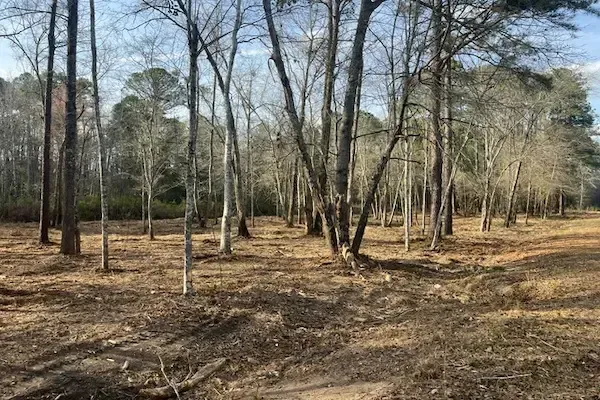
Forestry mulching uses a single tracked or wheeled machine equipped with a high-powered rotary cutting head to grind trees, brush, stumps, and dense vegetation right where they stand. Everything is processed in one pass — trees, root flares, briars, saplings, and all — and the resulting material is deposited back onto the ground as a 2–4 inch layer of wood chip mulch.
No burning. No hauling. No separate stump grinding. No debris piles to deal with after. One machine, one pass, one clean finished surface.
Side-by-Side Comparison
Speed & Efficiency
Traditional clearing requires coordinating multiple pieces of equipment, multiple crew members, and often multiple site visits. Debris management alone — burning or hauling — can take as long as the clearing itself.
Forestry mulching is one machine, one operator, one pass. For most commercial clearing projects, it's significantly faster from mobilization to the finished site.
Winner: Forestry Mulching
Soil Disturbance
Traditional clearing with bulldozers causes significant soil compaction and disturbance. The organic topsoil layer — the most biologically active and erosion-resistant layer of soil — is often removed or destroyed in the process. Recovering that soil health takes years.
Forestry mulching operates on top of the soil with minimal ground disturbance. The mulch layer left behind actually protects the soil and begins breaking down to replenish organic matter.
Winner: Forestry Mulching
Erosion Risk
This is one of the starkest differences between the two methods. Traditional clearing leaves bare, compacted soil exposed to rain and runoff — creating immediate, significant erosion risk. On slopes or near stormwater systems, this can be a serious problem that requires immediate erosion control measures.
Forestry mulching leaves the ground covered with a protective layer of organic material from the moment clearing is complete. That mulch acts as instant erosion control — absorbing rainfall impact, slowing runoff, and holding soil in place while natural vegetation reestablishes.
For commercial properties near retention ponds, drainage systems, or slopes, this difference is critical. Erosion from clearing operations is one of the leading causes of premature sediment buildup in stormwater ponds — and forestry mulching eliminates most of that risk.
Winner: Forestry Mulching
Environmental Impact
Traditional clearing — especially when it involves burning — releases stored carbon into the atmosphere and creates air quality impacts. Hauling debris to disposal facilities adds fuel consumption and disposal costs. The bare soil left behind is a source of sediment and pollutant runoff into local waterways until vegetation is reestablished.
Forestry mulching keeps the carbon stored in the vegetation on site, cycling it back into the soil as the mulch breaks down. There's no burning, no hauling, and no bare soil exposed to runoff. The environmental footprint is dramatically lower.
Winner: Forestry Mulching
Cost
This one is more nuanced. The per-hour rate for a forestry mulching machine is typically higher than a bulldozer. But when you factor in total project cost — multiple equipment mobilizations, debris hauling and disposal fees, burn permits, post-clearing erosion control installation — forestry mulching is almost always more cost-effective for the average commercial clearing project.
Where traditional clearing may have a cost advantage: large-scale site development projects that require full grading and soil preparation anyway. In those cases, the grading work has to happen regardless, and the additional cost of debris removal may be marginal compared to the overall project scope.
For most commercial overgrown lot clearing, pond bank clearing, right-of-way maintenance, and acreage reclamation, forestry mulching wins on total cost.
Winner: Forestry Mulching (for most commercial projects)
Best Use Case
Traditional clearing is best suited for: large development projects requiring full grading, sites where all vegetation and root systems must be completely removed, or situations where the ground will be completely regraded, and the natural soil profile is being replaced entirely.
Forestry mulching is best suited for: overgrown commercial lots, pond bank and slope clearing, right-of-way and easement maintenance, land reclamation for access or aesthetics, pre-development clearing where grading will follow, and any site where protecting the soil and minimizing erosion is a priority.
Winner: Context-dependent — but forestry mulching wins for the majority of commercial clearing needs
What This Means for Commercial Properties Near Stormwater Systems
For commercial property managers with retention ponds, detention basins, or other stormwater features on site, the choice between clearing methods has direct implications for your stormwater compliance.
Traditional clearing near a pond creates immediate sediment risk. Bare soil exposed to rain washes directly into your stormwater system — accelerating sediment buildup, reducing pond capacity, and potentially triggering compliance issues. You may find yourself spending money on erosion control measures and pond maintenance shortly after completing the clearing project.
Forestry mulching near stormwater features is the responsible choice. The mulch layer provides immediate ground cover, sediment stays where it belongs, and your stormwater system stays cleaner. It's not just better for the environment — it's better for your maintenance budget.
The Bottom Line
For most commercial and industrial land clearing needs, forestry mulching is faster, more environmentally responsible, more cost-effective in total project terms, and significantly less damaging to your soil and stormwater systems than traditional clearing methods.
At Carolina Outdoor Services, forestry mulching is our preferred approach for commercial clearing across South Carolina and North Carolina — and we have the equipment and experience to handle projects from a few overgrown acres to large commercial tracts.
If you have land that needs clearing and want to understand which approach makes the most sense for your specific site, let's talk.
📞 (803) 518-2787 · Mon–Fri, 7AM–5PM
Schedule Your Free Site Assessment
Serving commercial and industrial properties throughout SC & NC, including Lexington, Columbia, Aiken, Greenville, Spartanburg, and beyond.
Carolina Outdoor Services LLC | cosstormwater.com | Gilbert, SC

CONTACT INFO
Monday - Friday: 7:00 AM - 5:00 PM
1318 Peach Festival Road Gilbert, SC 29054
FAQs
What services does Carolina Outdoor Services provide?
We specialize in retention pond inspections and maintenance throughout South Carolina and North Carolina. Additionally, we offer industrial grounds maintenance and cutting services.
Why are retention pond inspections and maintenance important?
Retention ponds are crucial for managing stormwater runoff and preventing flooding. Regular inspections and maintenance ensure they function properly, comply with local regulations, and protect the environment.
Do you offer emergency services?
Yes, we provide emergency services for urgent issues such as flooding, storm damage, or hazardous conditions. Please contact us immediately if you require emergency assistance at (803) 518-2787.
Stormwater Management You Can Count On.
CONTACT INFO
Carolina Outdoor Services LLC
1318 Peach Festival Road
Gilbert, SC 29054
(803) 518-2787
Monday - Friday: 7 AM – 5 PM
FOLLOW US


© 2026 Carolina Outdoor Services, LLC | All Rights Reserved | Privacy Policy