
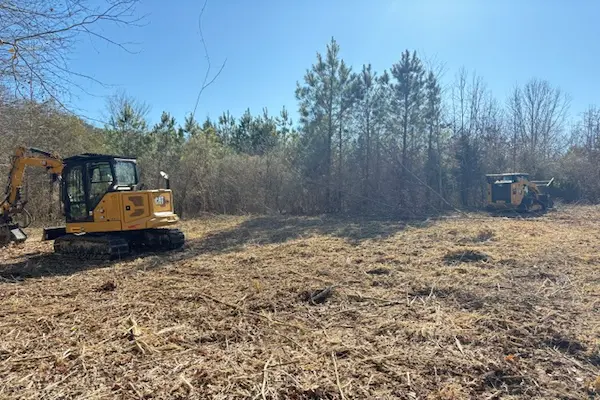
Forestry Mulching for Commercial Land Clearing in SC: What Developers and Property Owners Need to Know Before Breaking Ground
If you're preparing a commercial property for development, sale, or site activation in South Carolina — how you clear it matters more than most people realize going in.
The decision between forestry mulching and traditional land clearing isn't just about preference. It has real downstream consequences for your timeline, your site preparation costs, your erosion exposure during construction, and in some cases your stormwater permitting. Getting it right before the equipment rolls saves headaches that are very difficult to fix after the fact.
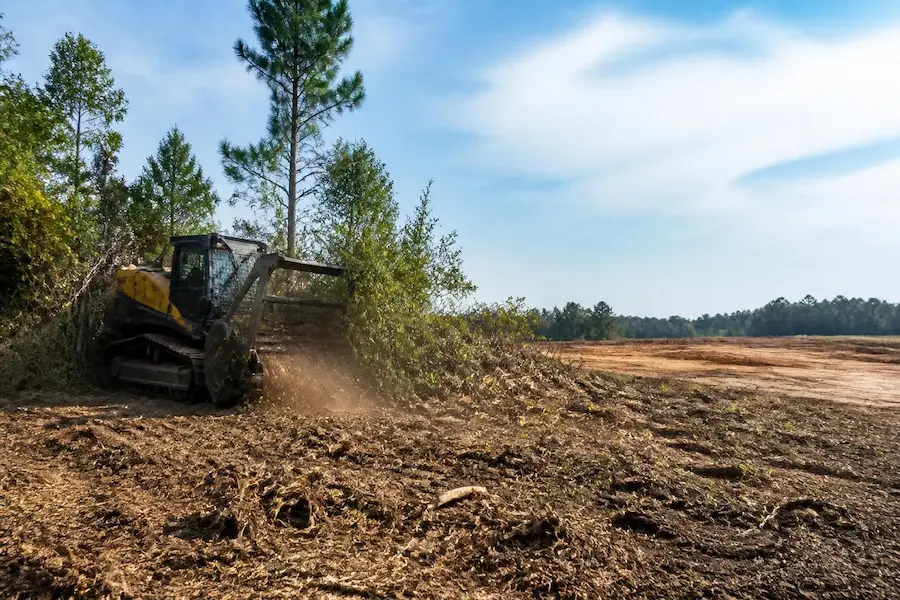
This is what 20 years of commercial land management in SC has taught us — and what every developer and commercial property owner should understand before making the call.
The Two Clearing Methods — Quickly Explained
Traditional land clearing involves multiple pieces of heavy equipment working in sequence. Bulldozers push trees and brush into piles. Grubbing equipment removes stumps and root systems. Everything gets piled and either hauled off or burned. The result is bare, graded ground — fully exposed, compacted, and requiring significant
work before construction can begin.
Forestry mulching uses a single specialized machine with a high-powered rotary cutting head to process trees, brush, stumps, and dense vegetation in place. Everything gets ground down in one pass. The material stays on site as a 2–4 inch mulch layer. No burn piles. No haul trucks. No weeks of equipment staging on your property.
The result: accessible, mulched ground that retains soil structure, resists erosion immediately after clearing, and is ready for whatever comes next — grading, site prep, stormwater infrastructure installation, or access development.
Why Forestry Mulching Works for Most Pre-Development Projects
For commercial development projects in SC — especially light commercial, mixed-use, industrial site prep, and residential subdivision preparation — forestry mulching is typically the right first step. Here's why:
1. Erosion control starts immediately. One of the most significant challenges in commercial development is erosion control on cleared ground. SCDHEC and local land disturbance permit requirements are specific about erosion and sediment control — and bare, compacted ground from traditional clearing is an erosion problem from day one.
Forestry mulching leaves a natural mulch layer on the surface that protects soil structure immediately after clearing. There's no window of vulnerability between clearing and erosion control installation — the mulch provides that function right away.
2. Soil structure is preserved. Tracked forestry mulching equipment distributes weight differently than heavy bulldozers and grubbing machines. Traditional clearing creates significant soil compaction — which can complicate grading, drainage design, and long-term stormwater management for your completed project. Mulching preserves more of the soil's natural structure going into construction.
3. One machine. One pass. Faster timeline. Multi-machine traditional clearing operations require equipment staging, sequencing, coordination, and time. A forestry mulching job on most commercial lots can be completed in a fraction of the time — which matters when you're managing a development timeline with contractors, permitting windows, and financing contingencies.
4. No waste disposal cost or liability. Burn piles require permits, create air quality concerns, and leave ash that has to be managed. Haul-off means dump truck runs and disposal fees. With forestry mulching, everything processed on site stays on site — there's no waste stream to manage or pay for.
5. Stormwater system access and staging is easier. If your development includes stormwater infrastructure — retention ponds, detention basins, drainage features — clearing with forestry mulching means your civil contractor or stormwater contractor is working with a stable, accessible site from the start, not bare compacted ground that turns to mud in the first rain event.
When Traditional Clearing Is the Right Call
Forestry mulching handles most commercial clearing projects — but not every project.
If your site requires large-scale grading that changes elevations significantly, or if you need root systems fully excavated below grade for foundation work or utilities, traditional clearing with grubbing may be the appropriate method. On those sites, the mulch layer and preserved root systems that make forestry mulching valuable elsewhere would actually complicate the grading and excavation work.
The right answer is always site-specific. That's exactly what a pre-project site assessment determines — what the land needs, what the project calls for, and which method (or combination of methods) gets the best result for your specific conditions.
Fall and Winter: The Smart Window for Pre-Development Clearing
If your commercial project is on the horizon — planned for Q1 2027, spring groundbreaking, or a development timeline that starts in the new year — fall and winter clearing is worth a serious look.
Dormant vegetation clears more efficiently. With deciduous trees and brush in dormancy, the full extent of vegetation is visible, and the clearing process is faster and more thorough.
Site conditions are favorable. SC fall and winter typically bring firmer, more stable ground — better footing for equipment, especially on sites with any slope or near drainage features.
You beat the spring rush. Commercial clearing crews are in high demand in spring, when developers who held off all winter are scrambling to get projects moving. Properties that clear in November and December have their sites ready and waiting when the rest of the market is just getting started.
And practically: the site that's been cleared, settled, and stabilized over winter looks and performs significantly better when your civil contractor shows up in March than one cleared the week before.
Talk to Us Before You Schedule the Excavator
If you have a commercial property that needs clearing before development, site activation, or sale preparation — the conversation with us should happen before the excavator is booked.
We come out, walk the site, and give you a straight assessment of what method is right, what the process looks like, and what a realistic timeline is for your project window. No cost. No obligation.
Forestry mulching season is open across SC and NC — and fall project slots are available now.
Call us at (803) 518-2787 or request a free site assessment.